When you rent a porta-potty in Albuquerque, specialized vacuum trucks arrive on-site to pump out the waste holding tank through a four-inch hose at 50-100 gallons per minute. Technicians then spray interior surfaces with high-pressure water mixed with disinfecting chemicals at 1,000-2,000 PSI before refilling the unit with fresh water and deodorizers. The entire sanitation process takes three to ten minutes per unit, with service frequency determined by user volume, event duration, and local temperature conditions that affect bacterial growth.
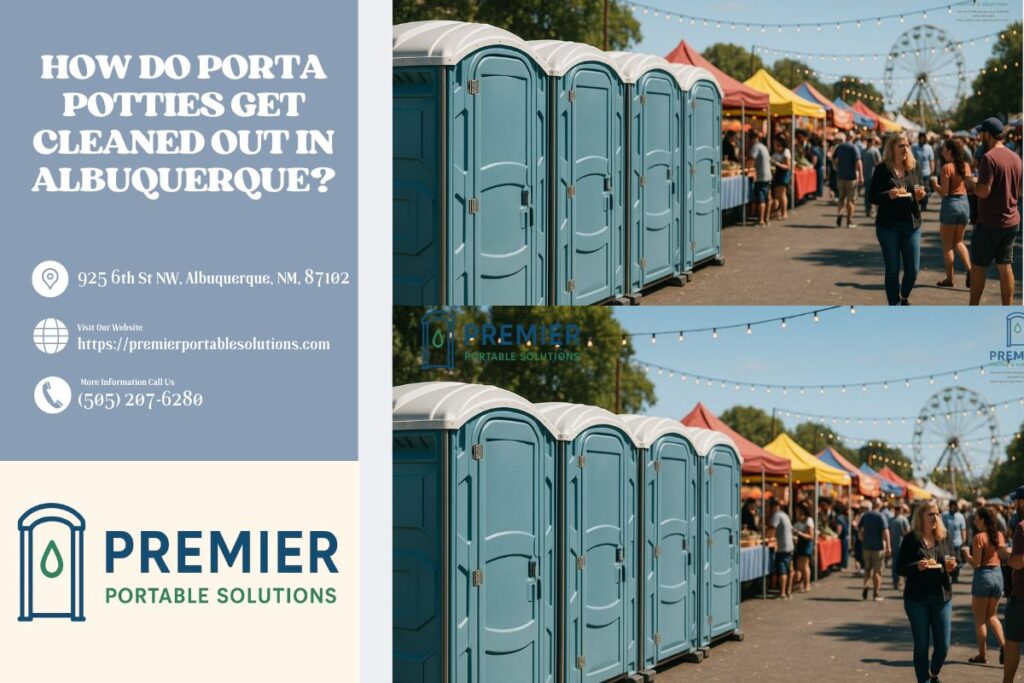
When a service truck arrives at your location, our technicians follow a systematic sanitation protocol developed over decades in line with industry standards.
The process begins with pumping out the waste holding tank using a vacuum hose connected to the truck’s sealed tank system. Next, technicians spray down all interior surfaces with high-pressure water mixed with specialized deodorizing and disinfecting chemicals.
The blue or green chemical solution you see isn’t just for odor control—it contains biocides that break down waste and neutralize harmful bacteria. After thorough scrubbing, they refill the tank with fresh water and treatment chemicals, restock toilet paper and hand sanitizer, and inspect critical components such as door latches and ventilation systems to ensure everything’s functioning properly for your continued use.
See also: Albuquerque portable toilet rental
Before any cleaning can occur, technicians must initially extract the accumulated waste using a vacuum truck’s specialized pumping system.
The truck’s powerful vacuum hose connects directly to the unit’s holding tank, creating negative pressure that efficiently removes all liquid and solid waste materials. You’ll find that our technicians position the hose strategically to guarantee complete extraction from the tank’s bottom, preventing residue buildup.
The vacuum system operates at sufficient pressure to handle the viscous nature of waste, combined with chemicals and toilet paper.
During this process, technicians monitor flow rates and tank levels to verify thorough emptying. The extracted waste is transferred directly into the truck’s sealed holding tank for proper disposal at authorized treatment facilities, ensuring environmental compliance and public health protection.
After the holding tank reaches complete evacuation, technicians immediately begin the refilling process with fresh water and chemical additives.
You’ll find they add a precise mixture of biocide and fragrance concentrate to the fresh water supply. This solution serves dual purposes: it controls odor through enzymatic action and breaks down waste materials for your next service cycle.
The standard ratio involves approximately 3-5 gallons of treated water in the holding tank. Technicians also refill the hand-washing station reservoir if your unit includes this feature.
They’ll spray deodorizing chemicals on interior surfaces, coating the bowl and walls. The blue or green liquid you see isn’t just for appearance—it contains formaldehyde alternatives that neutralize bacteria while providing visual confirmation of proper sanitation levels between services.
Professional sanitation requires specialized vacuum truck systems that Premier Portable Solutions deploys across Albuquerque for efficient waste removal.
| Equipment Component | Function | Capacity Specifications |
|---|---|---|
| Vacuum Pump System | Extracts waste tank contents | 50-100 gallons per minute |
| Fresh Water Tank | Stores clean rinse water | 200-400 gallons |
| Waste Holding Tank | Contains extracted sewage | 500-1,500 gallons |
| High-Pressure Sprayer | Cleans interior surfaces | 1,000-2,000 PSI |
| Chemical Dispenser | Applies deodorizers/biocides | 5-20 gallons |
You’ll notice our trucks feature industrial-grade 3-inch hoses for rapid extraction. The vacuum systems generate substantial suction power, completely emptying holding tanks within minutes. Fresh-water pressure washers sanitize surfaces, while chemical dispensers automate deodorizer application. This integrated equipment guarantees thorough cleaning that meets New Mexico health department standards.
At the core of every porta potty service operation sits a purpose-built vacuum truck equipped with twin tanks—one dedicated to waste collection, the other to maintaining fresh water reserves for cleaning cycles.
These specialized vehicles function as mobile sanitation stations, enabling your service technicians to complete full-service maintenance cycles on-site.
The vacuum system comprises:
You’ll find these trucks maintain consistent vacuum pressure throughout extraction, ensuring complete waste removal from each unit before the sanitization phase begins.
Hand-operated scrub brushes with stiff bristles address stubborn deposits, while microfiber cloths wipe down door handles, toilet seats, and urinal surfaces.
This methodical approach maintains sanitation standards between service intervals, protecting user health at construction sites, festivals, and outdoor events throughout Albuquerque.
Service frequency depends on usage volume and event duration. Premier Portable Solutions establishes maintenance schedules based on your specific requirements and local health regulations.
Standard service intervals include:
You’ll receive consistent servicing that prevents overflows and maintains sanitary conditions.
We monitor waste levels, weather conditions, and user counts to adjust schedules accordingly.
Albuquerque’s climate requires particular attention during the summer months when heat accelerates bacterial growth and odor development, often necessitating increased service frequency.
Most construction sites and permanent installations operate on weekly maintenance cycles that align with standard business operations. You’ll find that this schedule maintains adequate sanitation levels for typical use while controlling service costs. Premier Portable Solutions dispatches technicians every seven days to pump waste tanks, replenish consumables, and perform facility inspections.
| Service Component | Action Performed |
|---|---|
| Waste Removal | Complete tank evacuation via vacuum truck |
| Chemical Treatment | Fresh deodorizer and biocide application |
| Consumables | Toilet paper and hand sanitizer refill |
| Cleaning | Interior surfaces sanitized, floors mopped |
| Inspection | Structural integrity and lock functionality check |
High-traffic locations require accelerated schedules—sometimes bi-weekly or tri-weekly service intervals. You should communicate anticipated usage patterns during booking to guarantee appropriate maintenance frequency for your Albuquerque project site.
Large-scale events and peak-attendance venues demand service frequencies that exceed standard maintenance protocols.
You’ll find that high-traffic scenarios require adaptive servicing to maintain sanitary conditions and prevent capacity overload.
Premier Portable Solutions adjusts deployment and maintenance intervals based on your specific usage patterns:
You’re investing in usage-based scheduling that prevents the deterioration common with fixed-interval servicing.
Our dispatch system monitors consumption rates and triggers supplementary service calls when waste levels approach 75% capacity, ensuring your facilities remain functional throughout high-demand periods.
When our technician arrives at your location, they’ll complete a systematic seven-step protocol designed to restore full sanitary functionality.
Initially, they’ll pump out the waste holding tank using industrial vacuum equipment.
Next, they’ll pressure-wash all interior surfaces, including walls, floors, and the toilet seat.
Subsequently, they’ll apply EPA-approved disinfectants to eliminate bacteria and pathogens.
Fourth, they’ll refill the holding tank with fresh water and deodorizing chemicals.
Fifth, they’ll restock consumables like toilet paper and hand sanitizer.
Sixth, they’ll inspect hardware components—door latches, hinges, and ventilation systems—making minor repairs as needed.
Ultimately, they’ll document service completion and note any required follow-up maintenance.
This entire process typically takes ten to fifteen minutes per unit.
Our vacuum trucks extract waste through a four-inch diameter hose inserted directly into the holding tank’s access point. The powerful vacuum system creates negative pressure, efficiently removing all contents from the tank.
You’ll find our technicians systematically extract:
The extraction process typically takes three to five minutes per unit, depending on usage levels. Our technicians monitor the vacuum gauge to guarantee complete removal.
Once the tank’s empty, they’ll inspect the interior through the access point to verify no waste remains before proceeding to the next cleaning phase.
After tank evacuation, high-pressure water jets blast the unit’s interior surfaces at 2,000 to 3,000 PSI.
This forceful spray dislodges residual waste, toilet paper fragments, and biofilm from walls, floors, and the toilet seat. You’ll notice technicians systematically cover every surface, guaranteeing no contaminated areas remain.
Following the pressure wash, EPA-registered disinfectants are applied throughout the interior.
These antimicrobial solutions eliminate harmful bacteria, viruses, and pathogens that standard washing can’t remove. The sanitizing agent typically requires several minutes of contact time to achieve proper disinfection.
Technicians then rinse surfaces again, removing chemical residue while maintaining sanitation standards.
This multi-step process guarantees your rental unit meets health code requirements and provides users with a hygienic, odor-controlled facility that’s safe for public use.
Once vacuum trucks complete their collection routes, they transport the waste to approved sewage treatment facilities or wastewater processing plants.
These facilities process porta-potty waste through the same rigorous treatment protocols as residential sewage. You’re benefiting from established municipal infrastructure that guarantees proper waste management.
The treatment process includes:
Premier Portable Solutions maintains strict compliance with Albuquerque’s wastewater disposal regulations, assuring environmentally responsible waste management throughout our service operations.
Specialized vacuum trucks transport porta-potty waste directly from collection sites to licensed wastewater treatment facilities that meet EPA and New Mexico Environment Department standards.
These trucks carry permits and documentation required for legal waste disposal in Bernalillo County. During transport, sealed tanks prevent spillage and contain odors while maintaining public health standards.
Drivers follow designated routes to approved facilities, where they’ll discharge the waste through controlled connection points.
Treatment plants process the material using biological, chemical, and mechanical methods to separate solids from liquids. The treated water undergoes supplementary purification before release, while solid waste gets converted into biosolids for approved applications.
You’re benefiting from a regulated system that protects Albuquerque’s water resources and environment through proper waste management protocols.
New Mexico’s Water Quality Control Commission enforces strict regulations governing porta-potty waste disposal through the state’s Liquid Waste Program.
You’ll find that licensed haulers must comply with specific protocols to protect groundwater and public health throughout Albuquerque.
The disposal process requires adherence to these regulatory standards:
These safeguards guarantee your event’s sanitation needs don’t compromise environmental integrity.
While environmental regulations govern waste disposal, OSHA standards dictate the protective measures technicians must follow during porta-potty servicing operations.
Your service provider’s crews must wear personal protective equipment, including chemical-resistant gloves, safety glasses, and appropriate footwear, during all cleaning procedures.
Technicians require training in bloodborne pathogen protocols since portable restrooms may contain biohazardous materials. Proper ventilation practices prevent exposure to hydrogen sulfide and methane, which accumulate in holding tanks.
OSHA mandates specific lockout/tagout procedures when servicing equipment to prevent accidental pump engagement. Your provider should ensure eyewash stations are available on service vehicles and that technicians receive hepatitis vaccinations.
Furthermore, crews must practice proper hand hygiene protocols and maintain clean work areas to prevent cross-contamination between service locations.
Beyond basic protective equipment requirements, portable sanitation companies must maintain extensive compliance programs that address both worker safety and public health standards.
You’ll find that OSHA mandates specific protocols for handling biological hazards, while state and local regulations govern proper waste disposal methods. Premier Portable Solutions adheres to these thorough requirements through documented procedures and regular audits.
Critical compliance elements include:
The extensive compliance framework described above exists specifically to safeguard two distinct groups: the service technicians who perform the work and the end users who rely on sanitary facilities.
For technicians, protocols minimize exposure to biohazards through mandated PPE, proper waste-handling procedures, and equipment maintenance standards. These measures prevent occupational illnesses and injuries during servicing.
For users, compliance guarantees you’ll encounter facilities that meet documented sanitation thresholds. Regular service intervals help prevent bacterial proliferation, odor accumulation, and contamination.
When you use a properly maintained portable restroom, you’re benefiting from regulated chemical treatments, thorough tank evacuation, and surface disinfection procedures.
This dual-protection approach creates accountability throughout the service chain, from waste removal to site delivery, guaranteeing safe conditions for everyone involved.
Service intervals for portable restrooms aren’t arbitrary—they’re calculated based on measurable variables that directly impact waste accumulation rates and sanitation thresholds.
At Premier Portable Solutions, we determine your cleaning schedule by evaluating:
You’ll notice we adjust service frequency based on real-time usage patterns rather than rigid weekly schedules, ensuring ideal sanitation when you need it most.
Among all service variables, user count and rental duration produce the most predictable patterns of waste accumulation.
You’ll find that industry standards calculate approximately 10 uses per person per day at construction sites, while special events average 3-4 uses per person throughout the duration. A single unit accommodates roughly 200 uses before requiring service under normal conditions.
When you’re planning your rental in Albuquerque, you’ll need to consider both factors simultaneously. A two-week construction project with 20 workers demands different service intervals than a weekend festival serving 500 attendees.
We calculate holding tank capacity based on projected usage rates to determine optimal pumping schedules. High-traffic scenarios require mid-rental servicing, while low-use applications often need only post-rental cleaning.
This mathematical approach guarantees units remain functional and hygienic throughout your rental period.
Albuquerque’s high-desert climate introduces specific variables that directly impact porta-potty servicing requirements.
You’ll find that temperature extremes accelerate waste decomposition and increase the evaporation rate of chemical deodorizers. Event classification determines servicing frequency protocols.
Climate and event factors affecting service schedules:
Your rental duration and environmental exposure directly correlate with maintenance intervals.
Premier Portable Solutions calibrates servicing schedules based on these measurable variables to maintain sanitation standards.
You can request supplementary service calls beyond your scheduled maintenance. We’ll dispatch a vacuum truck to pump out the waste tank, replenish chemicals, and restock supplies. Extra service fees apply based on your location and service requirements.
If your unit tips over, you’ll need emergency service immediately. We’ll dispatch a crew to sanitize the affected area, remove the damaged unit, and install a replacement. Contact us right away for a rapid response and cleanup.
Yes, we offer ADA-compliant units featuring wider doorways, interior handrails, and wheelchair-accessible designs. These units meet federal accessibility standards and include supplementary space for maneuverability, ensuring compliance with disability accommodation requirements throughout Albuquerque.
Weekend porta-potty rentals in Albuquerque typically cost $150-$300 per unit, depending on the model you’ll select. Standard units run lower, while deluxe restroom trailers and ADA-compliant units command premium rates for your event.
You can place porta-potties on slopes up to 5 degrees, but we’ll use leveling blocks or shims to guarantee stability. Steeper grades require grading work initially to prevent tipping hazards and maintain proper waste tank function.




© 2026 Premier Portable Solutions. All Rights Reserved.