
For a standard 4-hour event near Albuquerque, you’ll need 2 portable restrooms per 100 attendees. However, local climate considerations greatly impact this baseline—Albuquerque’s summer temperatures exceeding 90°F typically require a 15-20% increase in units. Events serving alcohol need 30-40% more capacity, while gatherings lasting 6-8 hours should provide 3-4 units per 100 guests. Furthermore, at least 5% of your total rentals must be ADA-compliant to meet Bernalillo County regulations. Understanding these variables guarantees you’ll avoid sanitation issues and maintain peak guest comfort throughout your event.
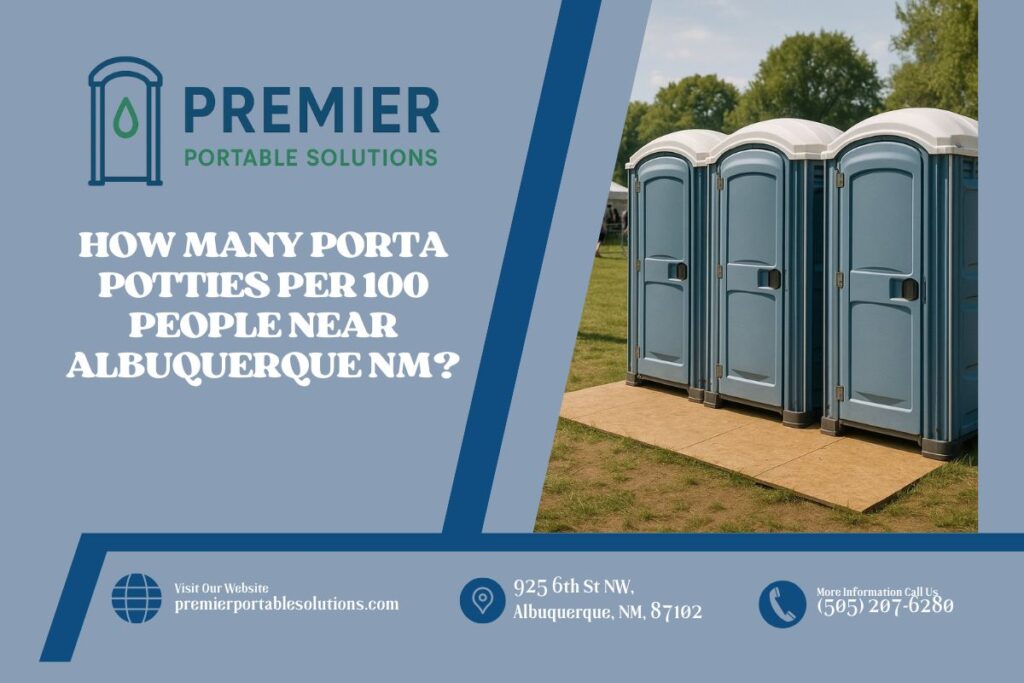
When planning events in the Albuquerque area, you’ll need approximately 1 portable restroom per 50 people for a standard 4-hour event.
However, this baseline ratio varies with specific event parameters. For events lasting more than 4 hours, you’ll need 1 unit for every 40 attendees.
Construction sites operating 40-hour workweeks need 1 unit per 10 workers, as mandated by OSHA regulations.
The standard calculations assume regular portable toilets without improved features.
You’ll need to account for extra variables, including event duration, alcohol service, and demographic composition.
Gender distribution notably impacts requirements—women typically need more facilities than men.
At Premier Portable Solutions, we recommend increasing the number of units by 20% when serving alcohol, as beverage consumption increases restroom usage frequency.
These industry-standard ratios guarantee adequate sanitation coverage for Albuquerque-area events.
See also: porta potty rental in Albuquerque
For a standard 100-person event lasting 4 hours, you’ll need 2 portable restrooms as a baseline. However, industry standards recommend adjusting this ratio based on specific event parameters. The Portable Sanitation Association International (PSAI) provides extensive guidelines that account for duration, alcohol service, and gender distribution.
| Event Duration | Units Required |
|---|---|
| 1-4 hours | 2 units |
| 4-6 hours | 3 units |
| 6-8 hours | 4 units |
| 8+ hours | 5 units |
These calculations assume standard usage patterns without alcohol. When alcohol’s served, increase capacity by 15-20% to accommodate higher restroom frequency. For construction sites or multi-day events, you’ll need one unit per 10 workers for adequate sanitation compliance. Premier Portable Solutions helps you determine ideal quantities based on your event’s unique requirements.
Event duration fundamentally transforms your portable restroom requirements, with usage patterns escalating markedly as hours accumulate.
For events lasting less than 4 hours, you’ll need 1 unit per 100 attendees. However, events lasting more than 4 hours require increased capacity—typically 1.5 units per 100 people for 6-hour gatherings, with ratios rising to 2 units per 100 for full-day events.
Long-duration events generate higher waste volumes and increased facility wear, necessitating extra units to maintain sanitary conditions. You’ll also need to account for limited servicing opportunities during extended events.
Multi-day festivals require even greater provisions—often three to four units per 100 attendees daily, plus regular pump-out services.
Consider temperature effects too; hot weather accelerates dehydration, increasing restroom frequency and demanding supplementary capacity beyond standard calculations.
Beyond timeline considerations, multiple variables interact to determine your precise portable restroom requirements.
Guest demographics greatly impact usage patterns—events serving alcohol typically need 30-40% more units due to increased frequency. Gender ratios matter: female attendees require longer restroom times, potentially doubling wait times at standard 50/50 splits.
Temperature extremes in Albuquerque’s climate affect hydration needs and corresponding restroom usage. Food service type influences requirements—full meals with beverages increase demand compared to light refreshments.
Event accessibility also plays a role; longer walks to facilities reduce usage efficiency. Construction sites and outdoor festivals have distinct calculation methods based on shift lengths and activity levels.
We’ll analyze your event’s specific characteristics to recommend appropriate unit quantities, ensuring adequate coverage without unnecessary costs.
Timing fundamentally transforms portable restroom calculations, with duration serving as the primary multiplier in all capacity formulas.
You’ll need to adjust your baseline ratio based on event length—a four-hour gathering requires fewer units than an eight-hour festival, even with identical attendance. Events exceeding six hours typically demand a 50% increase in standard recommendations, as guests consume more beverages and require supplementary facilities.
You should also consider peak usage patterns within your schedule. Concerts with intermissions, sporting events with halftime breaks, and conferences with scheduled recesses create surge demands that standard calculations don’t address.
These concentrated usage periods can overwhelm adequate unit counts. Multi-day events require daily servicing and potentially higher unit counts to maintain sanitation standards.
Premier Portable Solutions factors in these temporal variables in our Albuquerque recommendations, ensuring sufficient capacity throughout your event.
Beverage service dramatically escalates restroom demand, requiring you to increase your portable toilet count by 15-25% above standard ratios.
Alcohol consumption accelerates digestive processes and increases urination frequency, particularly during extended events. Beer and wine service typically requires one additional unit for 75-100 guests beyond baseline calculations.
Food service also impacts facility requirements. Heavy meals with high fiber content increase restroom usage within 60-90 minutes of serving.
Coffee stations and caffeinated beverages compound alcohol’s diuretic effects, further elevating demand. Consider menu composition when planning—spicy foods, dairy-heavy dishes, and protein-rich options generate different usage patterns.
For events combining full bars with substantial food service, apply maximum adjustment factors.
Premier Portable Solutions recommends boosting capacity by 25% for such occasions, ensuring adequate facilities throughout your Albuquerque event.
Each event category presents distinct restroom requirements that directly affect your portable toilet calculations.
Construction sites typically need one unit per 10 workers for an 8-hour shift, with additional units required for extended projects.
Weddings and formal gatherings demand higher ratios—one unit per 50 guests for a four-hour event—plus luxury restroom trailers for improved guest comfort.
Music festivals and outdoor concerts require one unit per 75 attendees, with ratios increasing to 1:50 when alcohol is served extensively.
Corporate events generally follow the 1:100 ratio for standard four-hour durations.
Sporting events need 1 unit per 150 spectators when permanent facilities are nearby, but 1:75 when alternative facilities are available.
Multi-day events require daily service visits and 30-50% extra units beyond standard calculations to maintain sanitary conditions throughout the duration.
Your guest count and event timeline determine the baseline porta-potty requirements, but several factors specific to social gatherings demand adjustments to standard ratios. Wedding receptions typically need more units than casual gatherings due to formal attire considerations and longer event durations.
| Event Duration | Units per 100 Guests |
|---|---|
| 1-2 hours | 1 standard unit |
| 3-4 hours | 2 standard units |
| 5-6 hours | 2-3 units |
| 6+ hours | 3-4 units |
You’ll want extra luxury restroom trailers for upscale weddings, particularly when permanent facilities aren’t available. Consider the alcohol service factor—open bars increase restroom frequency by approximately 15-20%. Gender ratio matters, too; female guests require 30% more time in the restroom. Premier Portable Solutions recommends installing hand-washing stations for buffet-style catering.
Large-scale public events require considerably higher porta-potty ratios than private gatherings due to limited alternative facilities and extended attendance periods.
You’ll need one portable restroom per 50 attendees for festivals and concerts lasting 4-6 hours. For all-day events lasting more than 8 hours, increase this to 1 unit per 40 people.
Consider these supplementary factors when planning your porta-potty requirements: alcohol consumption increases usage frequency by 30-40%; the presence of a food vendor affects demand; and event duration directly affects utilization rates.
You should also account for peak usage times—typically occurring mid-event and immediately following main performances.
For multi-day festivals, you’ll need improved servicing schedules and supplementary handwashing stations at a ratio of 1 per 4 porta-potties to maintain sanitary conditions throughout the event.
Because construction sites operate under strict OSHA regulations, your porta-potty requirements must meet specific compliance standards that differ markedly from event-based calculations.
OSHA mandates one toilet facility for every 20 workers on-site, regardless of shift duration. These aren’t suggestions—they’re enforceable standards designed to protect worker health and maintain productivity.
Construction Site Compliance Requirements:
You’ll also need a weekly servicing minimum, though high-traffic sites benefit from twice-weekly maintenance.
For Albuquerque’s construction projects, heat considerations require extra units during the summer months when workers increase hydration.
Non-compliance risks, citations, and workflow disruptions that cost more than the cost of proper facilities.
When planning porta-potty requirements for construction operations, understanding OSHA’s detailed recommendations extends beyond basic compliance minimums.
OSHA mandates one toilet seat and one urinal per 40 workers on construction sites, with facilities located within a 10-minute walk of the work area. You’ll need to ensure that facilities include proper ventilation, adequate lighting for nighttime operations, and enclosed structures that protect workers’ privacy.
OSHA requires toilet paper and regular servicing to maintain sanitary conditions throughout your project. For sites with more than 200 employees, you’re required to provide separate facilities for different work areas to minimize downtime.
Winter construction demands extra considerations, as OSHA expects you to maintain usable facilities regardless of weather conditions.
These federal standards establish baseline requirements that protect worker health and operational efficiency.
Construction workforce dynamics directly impact your porta-potty calculations in ways that exceed standard per-person ratios.
When crews rotate across multiple shifts, you’ll need supplementary units since workers don’t have time to wait during brief changeovers. Larger concentrated crews create peak usage periods that standard ratios don’t address.
Critical crew-based adjustments:
Premier Portable Solutions analyzes your specific crew schedule and calculates precise requirements to prevent costly productivity losses caused by inadequate facilities.
Different porta-potty configurations alter your quantity requirements since upgraded units serve fewer people more effectively than standard models.
Standard portable restrooms typically accommodate 10 workers over an 8-hour shift, while deluxe flushable units can serve 12-15 users due to improved comfort and ventilation that reduces dwell time.
ADA-compliant restrooms require separate calculations—you’ll need one wheelchair-accessible unit per event or job site, regardless of total attendee count.
Handwashing stations significantly increase your capacity; when you integrate dedicated wash stations, standard units handle 15-20% more since users spend less time inside.
High-capacity trailer restrooms can replace 6-8 standard units at large events, offering considerable spatial efficiency.
Premier Portable Solutions helps you optimize your configuration based on event duration, demographics, and specific comfort requirements throughout Albuquerque.
Standard porta-potties operate without running water or flushing mechanisms, while flushable units integrate freshwater tanks and foot-pump or battery-powered flush systems, which greatly affect user experience and capacity calculations.
When determining your rental quantities, consider these critical differences:
Premier Portable Solutions evaluates your event duration, guest expectations, and budget constraints to recommend the optimal unit type and quantity.
While standard porta-potties meet basic sanitation needs, federal law mandates ADA-compliant units for public events—requiring one wheelchair-accessible restroom for every 20 standard units or 5% of your total fleet, whichever is greater.
These units feature wider doorways, interior handrails, and spacious interiors accommodating mobility devices.
You’ll also need specialty units for specific demographics. Hand-washing stations should accompany every 8-10 standard units to maintain proper hygiene protocols.
For events lasting more than 4 hours, consider adding luxury restroom trailers with climate control and running water.
Construction sites require different ratios than festivals—typically one unit per ten workers for an eight-hour shift.
At Premier Portable Solutions, we’ll calculate your exact requirements based on event duration, attendee demographics, and Albuquerque’s regulations to guarantee full compliance.
Albuquerque’s high desert climate and unique regulatory environment directly impact your porta-potty requirements beyond standard ratios.
With average summer temperatures exceeding 90°F and intense UV exposure, you’ll need more frequent servicing to prevent waste breakdown and odor issues.
The city’s elevation at 5,312 feet affects waste decomposition rates, while seasonal events like the International Balloon Fiesta create unprecedented demand spikes.
Critical Albuquerque-specific factors:
These local variables mean you can’t rely solely on generic porta-potty calculators.
Three environmental factors dramatically accelerate porta-potty deterioration and usage rates: sustained temperatures above 85°F, humidity levels exceeding 60%, and events lasting longer than four hours.
Albuquerque’s desert climate, with summer temperatures frequently surpassing 90°F, intensifies odor accumulation and dehydration-driven restroom visits. You’ll need to increase your unit count by 15-20% during peak summer months compared to spring calculations.
High-usage conditions—including alcohol service, food vendor presence, and limited shade availability—compound these challenges.
Events featuring beer gardens or extended outdoor exposure can double standard usage rates. We recommend adding one extra unit per 75 guests when multiple accelerating factors converge.
For multi-day festivals or construction projects, implementing twice-daily service intervals maintains sanitation standards that single daily servicing can’t achieve in extreme conditions.
Strategic porta-potty placement requires adherence to specific distance parameters and ADA compliance standards, both of which directly impact guest satisfaction and legal obligations.
You’ll need to position units within 300 feet of high-traffic areas, while maintaining a 50-foot minimum distance from food service zones. ADA-compliant units must comprise at least 5% of your total rental count and feature interior dimensions of at least 60×60 inches.
Critical Placement Considerations:
Premier Portable Solutions guarantees compliant, strategic positioning throughout Albuquerque.
When porta-potty wait times exceed three minutes, you’re witnessing a cascading failure that compromises both guest experience and sanitation standards.
Extended queues put pressure on facilities, reducing time for proper handwashing and increasing contact points where contaminants can spread.
You’ll prevent these issues by calculating the appropriate number of units based on event duration and attendance patterns.
Industry data shows that ideal ratios maintain average wait times of 2.5 minutes during peak usage periods. For events exceeding four hours, you’ll need extra units as waste accumulation reduces functional capacity and service quality deteriorates.
Strategic placement minimizes congregation bottlenecks—position units across multiple clusters rather than in a single, concentrated area.
You’re also protecting public health by ensuring adequate servicing intervals.
Premier Portable Solutions recommends supplementing standard ratios with handwashing stations to maintain hygiene protocols throughout your event.
An ideal porta-potty deployment requires synchronizing unit quantity with maintenance intervals to maintain sanitation standards throughout your event.
You’ll need to evaluate waste accumulation rates against servicing schedules to prevent capacity overruns. High-traffic events demand either increased unit counts or accelerated pump-out frequencies.
Critical factors affecting your servicing strategy:
Standard practice is to service every 40-60 uses or every three days for multi-day events.
Premier Portable Solutions calculates ideal ratios by analyzing your attendance patterns, event duration, and site accessibility to prevent sanitation failures.
Because restroom demand fluctuates dramatically during scheduled breaks and meal periods, you’ll need to allocate 25-40% more units than baseline calculations suggest.
Construction sites experience peak usage during lunch hours (typically 11:30 AM-1:00 PM), while festival attendees converge on facilities during headliner changeovers and intermissions.
You should calculate your maximum occupancy load—the highest number of simultaneous users—rather than average attendance.
For events with defined intermissions, you’ll see 60-75% of your total crowd accessing facilities within a 15-20-minute window. This surge capacity requires supplementary units beyond standard ratios.
Premier Portable Solutions recommends strategically positioning extra facilities near high-traffic areas during peak periods.
We’ll help you analyze your event’s schedule to determine ideal unit quantities, ensuring adequate capacity when your guests need it most while avoiding unnecessary expenses.
Standard porta-potties typically cost $75-$150 per unit per day, while luxury restroom trailers range from $200-$500 per unit per day. You’ll pay 2-4 times more for premium units, but they offer upgraded amenities, climate control, and improved guest experience at upscale events.
For multi-day events, you’ll need porta-potty servicing every 2-3 days under normal usage conditions. High-traffic events require daily service to maintain sanitation standards, ensure adequate supplies, and prevent waste tank overflows.
Yes, you can rent porta-potties for residential use in Albuquerque neighborhoods. They’re ideal for home renovations, backyard parties, or when plumbing’s unavailable. We’ll handle delivery, placement, and servicing to meet your specific residential needs.
If attendance exceeds your estimate, you’ll face longer wait times, unsanitary conditions, and guest dissatisfaction. We recommend ordering 10-15% extra units as contingency. Contact us immediately if numbers surge—we’ll deploy supplementary portable restrooms quickly.
Hand-washing stations are available as separate rental units but aren’t automatically included with standard porta-potty rentals. You’ll need to request them specifically. We recommend one handwashing station for every 2 to 4 portable restrooms to ensure optimal hygiene compliance.



© 2026 Premier Portable Solutions. All Rights Reserved.